Navratna Gemstones: Which Ratna Does Your Horoscope Actually Need
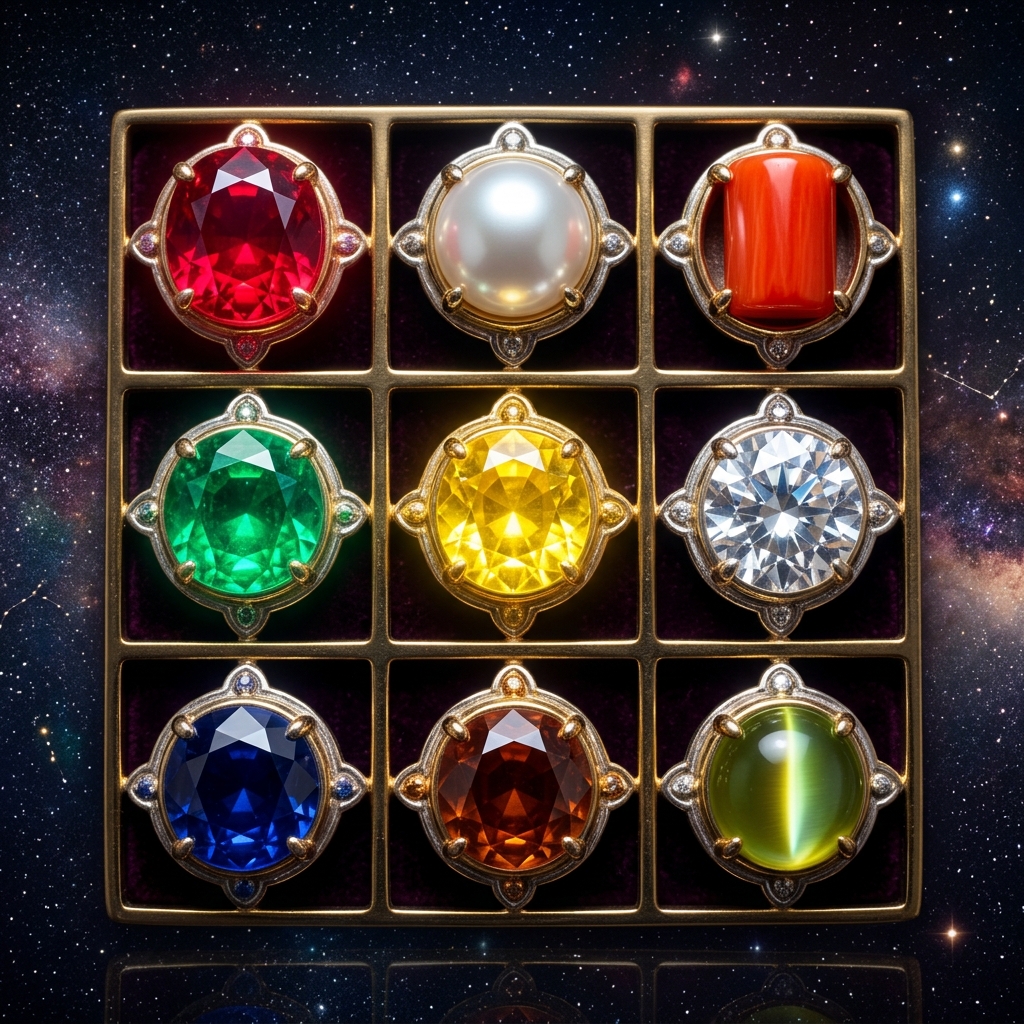
People come to me every week asking about gemstones. Some have already bought a blue sapphire from a shop that assured them it was "good for everyone." Others are wearing five different stones simultaneously, advised by five different people. Both situations concern me, and for the same reason: a gemstone worn without examining the birth chart is not a remedy. It is a gamble.
Vedic astrology treats gemstones as planetary amplifiers. Each of the nine classical planets, the Navagrahas, corresponds to a specific gem. When that gem touches your skin, it is thought to strengthen the electromagnetic and subtle energy of that planet in your life. The critical question is: which planet in your chart needs strengthening, and which should absolutely not be touched?
Let me walk you through the Navratna system with the detail it deserves.
The Nine Gems and Their Planets
The word Navratna comes from Sanskrit: nava meaning nine, and ratna meaning gem. The nine gems map directly onto the nine grahas, and each planet rules specific domains of life. Strengthening a benefic planet through its stone can accelerate progress in those domains. Strengthening a malefic or badly placed planet can have the opposite effect.
| Planet | Gem (Primary) | Substitute | Rules |
|---|---|---|---|
| Sun (Surya) | Ruby (Manikya) | Red Garnet, Red Spinel | Career authority, father, health |
| Moon (Chandra) | Pearl (Moti) | Moonstone, White Coral | Mind, mother, emotions, water |
| Mars (Mangal) | Red Coral (Moonga) | Carnelian | Energy, courage, property, siblings |
| Mercury (Budha) | Emerald (Panna) | Green Tourmaline, Peridot | Speech, intellect, business, communication |
| Jupiter (Guru) | Yellow Sapphire (Pukhraj) | Yellow Topaz, Citrine | Wisdom, children, wealth, husband |
| Venus (Shukra) | Diamond (Heera) | White Sapphire, Zircon | Marriage, luxury, arts, wife |
| Saturn (Shani) | Blue Sapphire (Neelam) | Amethyst, Blue Spinel | Karma, discipline, longevity, career |
| Rahu | Hessonite (Gomed) | Zircon (brown) | Foreign, sudden change, unconventional paths |
| Ketu | Cat's Eye (Lehsunia) | Tiger's Eye | Spirituality, past lives, hidden enemies |
Why You Cannot Wear Any Stone You Like
This is the part most gemstone sellers will not tell you. Some planets are natural enemies of each other. Sun and Saturn do not get along; their gems, Ruby and Blue Sapphire, should never be worn together. Similarly, Jupiter and Venus have a complicated relationship in Vedic astrology, and wearing their stones simultaneously can create contradictory energies in the body.
More importantly, whether a planet helps or hinders you depends entirely on its placement in your specific birth chart, your Kundli. A Saturn that rules your 9th and 10th house in a Taurus ascendant is very different from a Saturn that rules the 12th in a Gemini ascendant. The first can be supported with a Blue Sapphire; the second is likely better left alone or supported through other means like mantra or donation.
The house a planet occupies matters too. A planet sitting in its own sign, in exaltation, or in a kendra (1st, 4th, 7th, or 10th house) from the ascendant is already functioning well and can be further amplified. A debilitated or combust planet is struggling, and wearing its gem is like putting more fuel into an engine that is already misfiring.
How to Identify Your Correct Gemstone
Start with your ascendant, your Lagna. The lord of your ascendant is almost always safe to strengthen. For a Leo ascendant, the Sun rules the first house, so a Ruby is generally supportive. For a Sagittarius ascendant, Jupiter rules the first and also the fourth house of home and mind, so a Yellow Sapphire is usually beneficial. For a Virgo ascendant, Mercury rules both the first and tenth houses, making an Emerald a strong choice for career and personality.
Beyond the Lagna lord, look at the lord of your 9th house (fortune, higher learning, father) and your 10th house (career, status, action). These are called trikona and kendra lords respectively, and their combined strength is the foundation of Raj Yoga in Vedic astrology. Strengthening these lords through gems tends to produce the most visible results.
What you want to avoid are stones for planets that rule the 6th, 8th, or 12th houses from your ascendant, especially if those planets are not simultaneously ruling a good house. The 6th rules enemies and illness, the 8th governs sudden disruption and hidden debts, the 12th covers losses and foreign travel in complicated ways. Strengthening these can intensify problems rather than solve them.
Quality, Weight, and How to Wear
A low-quality gem with inclusions does not give results. The traditional rule is that a stone must be eye-clean or better, meaning free of visible inclusions to the naked eye. For the primary gems like Ruby and Blue Sapphire, even small stones of excellent clarity will outperform large stones of poor quality.
The weight recommendation in Vedic astrology is typically calculated based on your body weight, usually around 1 carat per 10 kilograms of body weight, with a minimum threshold depending on the gem type. A Ruby should be at least 2 to 3 carats for meaningful effect; a Yellow Sapphire, at least 3 carats; a Blue Sapphire, 2 carats minimum.
Each gem is set in a specific metal. Ruby goes in gold or copper, Pearl in silver, Red Coral in silver or copper, Emerald in gold, Yellow Sapphire in gold, Diamond in gold or platinum, Blue Sapphire in silver or gold, Hessonite in silver, and Cat's Eye in silver. The stone should touch the skin of the finger it is assigned to. Gems kept in a closed-back setting with no skin contact provide minimal benefit.
The finger also matters: Sun and Ruby go on the ring finger, Moon and Pearl on the little finger, Mars and Red Coral on the ring finger, Mercury and Emerald on the little finger, Jupiter and Yellow Sapphire on the index finger, Venus and Diamond on the ring finger, Saturn and Blue Sapphire on the middle finger, Rahu and Hessonite on the middle finger, Ketu and Cat's Eye on the middle finger. These assignments come from the Jyotish tradition and are consistent across most classical texts.
The Trial Period and When Results Appear
Classical texts recommend wearing a new gem first for a trial of three to seven days before making a permanent commitment. During this time, observe your sleep, your mood, your energy, and any unusual events. A correct gem usually produces a noticeable lightness or clarity within the first week. An incorrect one may cause headaches, disturbed sleep, increased conflict, or unusual tiredness.
If the trial is positive, wear the gem continuously. Remove it only for major rituals or medical procedures. Do not lend your gemstone to anyone; it absorbs your personal energy over time and becomes attuned to you specifically.
For most people, results from a well-chosen gemstone become perceptible within 40 days. Full integration takes about six months. If you notice no change after three months, revisit the choice with your astrologer, because either the quality of the stone, the chart analysis, or the wearing method needs adjustment.
Not sure which gemstone matches your birth chart? Use the free Lucky Gemstone Finder to get a Vedic astrology recommendation based on your date of birth and ascendant sign.
Find Your GemstoneA Word on Substitute Stones
Not everyone can afford a natural Ruby of good quality or a genuine Blue Sapphire. The classical tradition acknowledges this and permits upratna, substitute gems. These are less expensive stones that carry a similar planetary signature at lower intensity. A Yellow Topaz carries about 60 to 70 percent of the energy of a natural Yellow Sapphire. A Green Tourmaline works similarly to an Emerald for Mercury.
For Rahu and Ketu, the substitutes are actually quite effective because their primary gems, Hessonite and Cat's Eye, are already affordable. The substitutes for Sun (Red Garnet) and Moon (Moonstone) are gentler and well-suited for people with sensitive constitutions who find the primary gem too strong.
What substitutes cannot do is replace a genuine primary gem for serious chart remediation. If someone has a critical 7th house affliction affecting marriage and needs Venus strengthened, a Zircon will help, but a fine Diamond will work considerably faster and more powerfully. In high-stakes situations, the primary gem is always preferable when affordable.
Common Mistakes to Avoid
The most common mistake I see is people wearing the Navratna ring, all nine gems together, as a general protective talisman. This sounds appealing but is actually contradictory for most people. You are simultaneously strengthening planets that are friends and planets that are enemies to your ascendant. The net effect is usually neutral at best, and occasionally disruptive when the malefic planets in your chart get amplified.
The second common mistake is buying stones from a seller who tests your gem on the basis of colour alone. Colour indicates the planet association, yes, but a heat-treated or glass-filled ruby has an entirely different energetic profile from a natural, untreated ruby. Always ask for a gem certificate from a recognised gemmological laboratory: GIA, IGI, or a reputable Indian lab. The certificate should state that the gem is natural and note any treatments.
Third: do not wear a gem simply because someone else is getting results from it. Even if your best friend's Blue Sapphire changed her life, you have a different chart. Saturn may be your friend or your tormentor depending entirely on your ascendant and its placement in your Kundli.