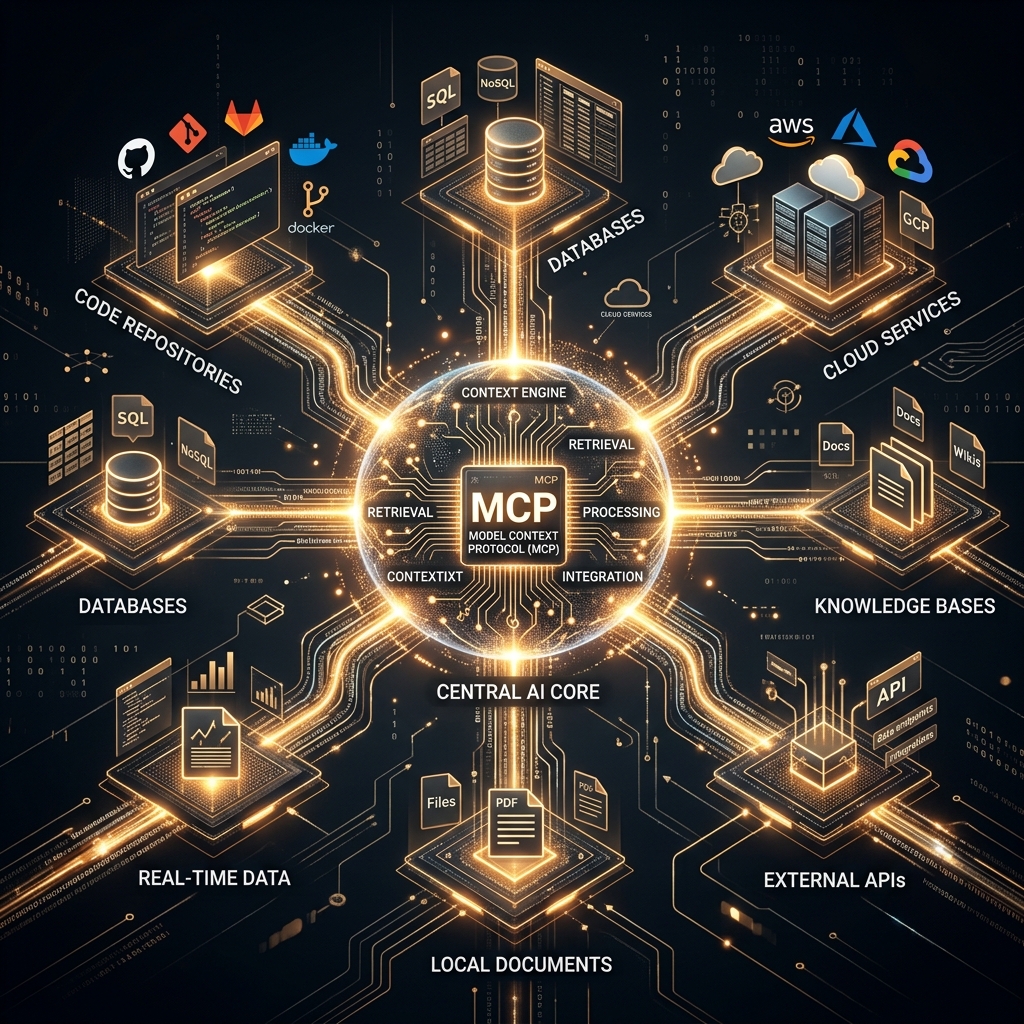
We are witnessing a fundamental shift in how we interact with Large Language Models (LLMs). For years, the paradigm was simple: Text In, Text Out. You ask ChatGPT a question, and it gives you an answer based on its training data. But that era is ending.
The new era is Text In, Action Out. And the key to unlocking this agentic future is a seemingly modest standard called the Model Context Protocol (MCP).
“MCP is not just an API; it is the universal adapter that turns a chatbot into a colleague. It allows AI to leave the chat window and enter the codebase, the database, and the workflow.” — Dr. Dhaval Trivedi
The Problem with "Siloed" Intelligence
Until recently, connecting an LLM to your internal data was a nightmare of custom integrations. You had to build bespoke connectors for your PostgreSQL database, your Slack channels, your GitHub repositories, and your internal documentation.
Every time you wanted to switch models—say, from GPT-4 to Claude 3.5 Sonnet—you often had to rewrite the integration layer. The intelligence was trapped in a silo, disconnected from the tools where work actually happens.
Enter MCP: The Universal Standard
The Model Context Protocol solves this specifically by standardizing how AI models browse and interact with external context. Think of it like USB-C for AI. Instead of building a specific connector for every model-tool pair, you build an MCP Server once.
Here is why this changes the landscape for developers and businesses:
- Standardization: Developers write an MCP server for their resource (e.g., a "Database Supervisor") once, and any MCP-compliant client (like Claude Desktop or Cursor) can use it immediately.
- Security: MCP runs locally or via controlled gateways. You aren't uploading your entire database to the cloud; you are giving the model a secure, structured way to query it on demand.
- Agentic Behavior: Because MCP provides a standardized way to expose "prompts" and "tools," models can now chain actions together more reliably. They don't just "read" data; they can act on it if permitted.
Real-World Application: The "Coding Agent"
As a developer and Technical Project Manager, the most immediate impact I see is in coding environments. Tools like Cursor and Windsurf are already blurring the line between IDE and AI.
With MCP, an AI doesn't just "suggest" code. It can:
- Read the latest logs from your production server.
- Check the current state of a linear ticket.
- Query the database schema directly to ensure the SQL query it generates is valid.
- Execute the migration within a sandboxed environment.
It turns the AI from a "smart typewriter" into a "junior engineer" that has read-access to the same tools you do.
What This Means for Business Strategy
For organizations, the message is clear: Stop building custom chatbots that only know about PDF documents. Start building MCP-compliant infrastructure.
If your internal APIs and data lakes are exposed via MCP, you are future-proofing your stack. Whether the winner of the AI arms race is OpenAI, Anthropic, or Google DeepMind won't matter to you—because your data is ready for any of them.
Integrate AI into Your Workflow
Don't just chat with AI—build with it. I help companies design MCP-ready architectures and deploy secure, agentic AI systems.
Explore AI Consulting