Guna Milan and Beyond: How Numerology and Astrology Read Love Compatibility
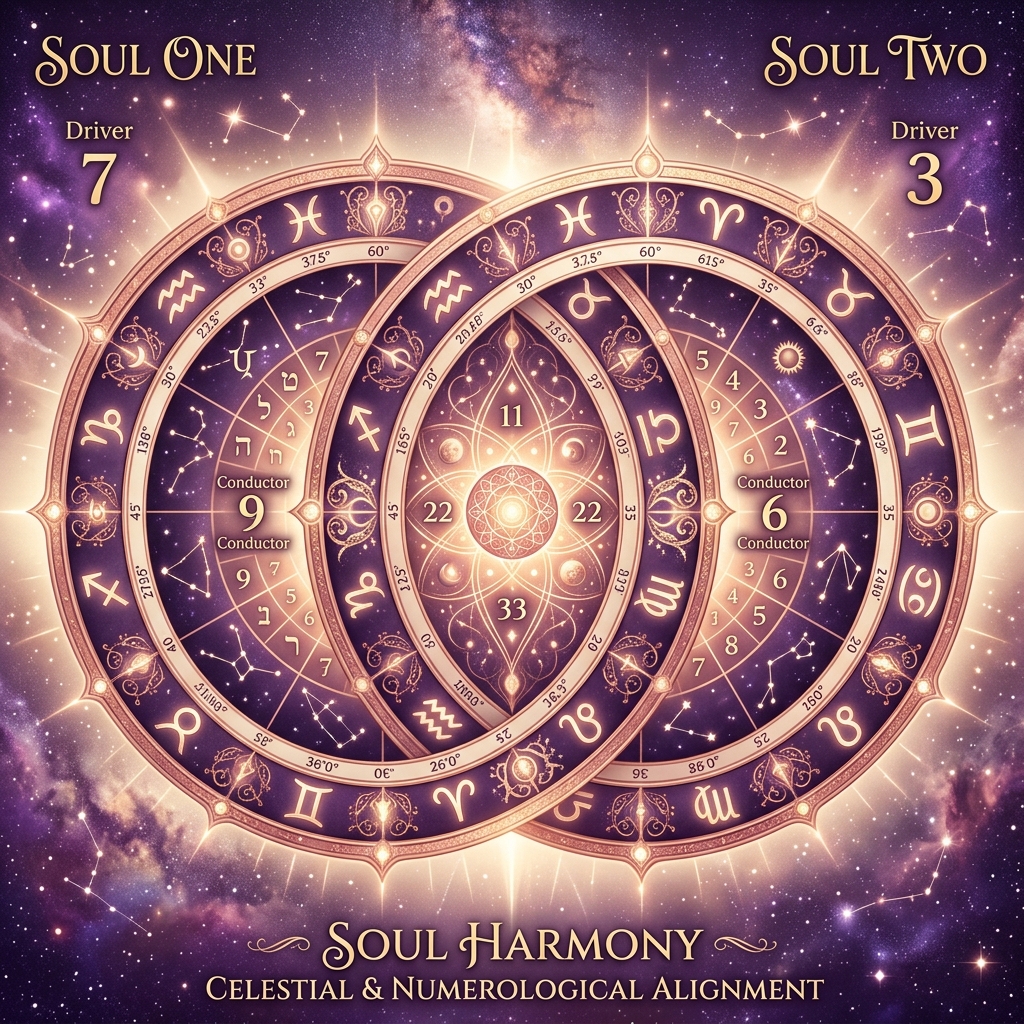
Questions about relationships are, by far, the most common reason people come to see an astrologer or numerologist. Not career, not health, not money: love. This has been true as long as there have been practitioners of these arts. The Brihat Parashara Hora Shastra, the foundational text of Vedic astrology, devotes entire chapters to the assessment of compatibility between partners. The tradition understood, thousands of years before psychology named it, that the wrong partnership is one of the most significant sources of human suffering.
The Vedic approach to compatibility is systematic and multi-layered. It does not rely on a single measure. Instead, it builds a picture from multiple angles: the Moon signs, the Nakshatras, the Dashas, the planetary aspects between two charts, and the numerological compatibility between the two people's birth numbers. Each layer adds specificity. A high score on one measure and a low score on another tells you something very precise about where a relationship will thrive and where it will struggle.
Ashtakoot Guna Milan: The Eight-Factor System
The primary compatibility analysis in Vedic astrology is called Ashtakoot, meaning eight categories, and it is specifically based on the Moon signs and birth Nakshatras of both individuals. The eight categories are Varna, Vashya, Tara, Yoni, Graha Maitri, Gana, Bhakoot, and Nadi. Together they add up to 36 maximum points.
Varna (1 point): represents the spiritual compatibility and the broad psychological type. The four varnas are Brahmin, Kshatriya, Vaishya, and Shudra, corresponding to the twelve Rashis in a specific pattern. Compatibility is highest when the groom's varna is equal to or higher than the bride's.
Vashya (2 points): represents the degree of mutual attraction and control between partners. The five vashya categories are Manav (human), Chatushpad (quadruped), Jalchar (water-dwelling), Vanchar (wild animal), and Keet (insect). Matching categories or favourable combinations earn full points.
Tara (3 points): checks the Nakshatra compatibility by counting from one partner's Nakshatra to the other's and determining whether the count falls on an auspicious star. This is a nuanced calculation that considers birth stars, not just signs.
Yoni (4 points): represents sexual compatibility and physical temperament. Each of the 27 Nakshatras is assigned an animal symbol, and the compatibility between the two animals determines the score. Sworn enemy animals score 0; same animals score full marks.
Graha Maitri (5 points): compares the lords of the Moon signs of both partners and determines whether those planets are friends, neutral, or enemies toward each other. This is often the most psychologically revealing factor: the Moon sign lord represents how you instinctively think and feel, and when the lords are planetary enemies, partners frequently find that their emotional default modes work against each other even when they consciously agree.
Gana (6 points): each Nakshatra belongs to one of three Ganas: Deva (divine, sattvic), Manava (human, rajasic), or Rakshasa (demonic, tamasic). Same-gana matches score highest; Deva and Manava work reasonably well together; Deva and Rakshasa combinations are considered the most challenging. This factor speaks to fundamental values and life approach, not character defects: Rakshasa Gana people are intense, transformative, and unconventional, not literally demonic.
Bhakoot (7 points): compares the relative positions of the two Moon signs and checks for patterns associated with financial stress, health issues, or lack of children. This is considered one of the most important factors in the eight, second only to Nadi. Certain Bhakoot combinations like 2/12, 5/9, and 6/8 from each other are traditionally considered highly problematic.
Nadi (8 points): the highest-scoring factor, representing health and progeny. Each Nakshatra belongs to one of three Nadis: Adi, Madhya, or Antya. When both partners share the same Nadi, the full 8 points are lost, and this is considered a serious mismatch that can affect health and the ability to have children. Traditional practice considers same-Nadi matches unacceptable for marriage without specific remediation.
A total score of 18 or above out of 36 is considered acceptable for marriage. Above 24 is good. Above 30 is excellent. Below 18 traditionally calls for remediation or caution.
What the Score Does Not Tell You
Guna Milan is necessary but not sufficient for a complete compatibility assessment. A score of 30 does not guarantee a happy marriage, and a score of 14 does not preclude one. The reason is that Guna Milan only examines the Moon signs and Nakshatras; it says nothing about the rest of the birth chart.
Two people can have excellent Guna Milan but catastrophically incompatible Venus placements, which govern love and partnership directly. Or they may have harmonious charts but both be in difficult Dasha periods simultaneously, creating a situation where neither partner has the inner resources to support the other. Or the 7th house of marriage in one or both charts may be severely afflicted, meaning that the relationship itself will be the arena where unresolved karma gets worked out regardless of how well the Moon signs match.
Full compatibility analysis looks at: the condition of the 7th house and its lord in each chart; the condition of Venus; the Darakaraka (the planet with the lowest degree in the birth chart, representing the partner); any malefic aspects or occupations of the 7th house; and the current Dasha-Antardasha periods of both individuals relative to marriage timing. This is considerably more involved than an Ashtakoot score, and it is why a chart reading is not replaceable by a score alone.
The Manglik Dosha: Fear vs. Reality
One cannot discuss marriage compatibility in Vedic astrology without addressing Manglik Dosha (Kuja Dosha). This occurs when Mars is placed in the 1st, 4th, 7th, 8th, or 12th house from the Ascendant (and sometimes from the Moon or Venus). Because Mars is a planet of heat, aggression, and intense energy, its presence in these houses can create friction in partnership.
However, the fear surrounding Manglik Dosha is often disproportionate. The tradition provides numerous cancellations (Bhanga). If the other partner is also Manglik, the energies balance out. If Mars is in its own sign or exaltation sign, its malefic nature is significantly reduced. More importantly, Manglik Dosha is not a "curse" that prevents marriage; it is simply a requirement for a partner who can match your intensity. Remedies like the Kumbh Vivah or regular worship of Lord Kartikeya are effective for those with a high degree of Mars affliction.
Numerological Compatibility: Driver Numbers
Alongside the astrological assessment, numerology offers its own compatibility reading through the Driver numbers of both partners. The Driver number is derived from the day of birth, reduced to a single digit. Since there are nine possible Driver numbers and each carries a planetary ruler, compatibility between partners follows the same logic as planetary friendship and enmity.
Attraction but tension. The 1 needs recognition; the 4 challenges authority. Works well when the 4 channels their rebel energy productively.
Natural complement. The 1's confidence is balanced by the 2's sensitivity. One of the better pairings in numerology.
Good friendship, strong creative partnership. Both are fire-natured and enthusiastic. They understand each other's ambition.
Strong attraction; classic romantic pairing. Venus softens Mars; Mars energises Venus. Potential for dependency if not managed consciously.
Intellectually stimulating but often unstable long-term. Both crave freedom and variety. Needs shared purpose to sustain depth.
Can work but demands effort. Both see the world unconventionally, but their coping mechanisms differ. Requires patience and mutual respect.
Traditional enemies. The 1 wants authority and recognition; the 8 wants discipline and long-term building. Power struggles are common unless both have high self-awareness.
Deep emotional resonance. The 7's need for introspection is understood by the 2's empathy. Can be highly spiritual partnership or deeply co-dependent.
The numerological compatibility reading is faster and simpler than a full Guna Milan, but it captures something the astrological system can miss: the psychological and motivational compatibility between two people as expressed through their dominant personal number. I use it as a first filter and a second opinion, not as a standalone verdict.
When Both Systems Agree and When They Diverge
The most reliable compatibility assessments occur when both systems point in the same direction. When Guna Milan is strong and the Driver numbers are compatible, the probability of a harmonious relationship is substantially higher. When both systems flag problems, the concerns are usually real and worth addressing before committing.
The interesting cases are when they diverge. I have seen couples with poor Guna Milan but highly compatible Driver numbers who have built strong, lasting partnerships through sheer mutual understanding and effort. I have seen the reverse: high Guna Milan scores but Driver numbers in complete opposition, where the couple is technically compatible on every Nakshatra measure but finds everyday life filled with unaccountable friction.
My reading of these cases is that the astrological compatibility speaks to fate and karma: what the relationship is destined to confront and resolve. The numerological compatibility speaks to personality and psychology: how the two people naturally relate on a day-to-day basis. You can have good karma with someone and still find them temperamentally challenging, and vice versa. The ideal is when both layers align.
The Role of Timing in Relationship Success
Even a highly compatible couple can face severe challenges if they come together during a period when one or both partners is running a Dasha that activates their chart's most difficult sectors. A Saturn Mahadasha activating an afflicted 7th house will produce relationship stress for almost anyone, regardless of how well-matched their partner is. Similarly, a Rahu Mahadasha often brings unexpected changes in relationships, not because the partner is wrong but because Rahu's nature is to dissolve established patterns.
Timing is why I never assess compatibility without also looking at where both people are in their Dasha cycles. A marriage begun during a favourable Dasha for both partners has a very different trajectory than one that begins when one person is mid-Rahu Mahadasha and the other is in a Saturn return equivalent period. The relationship is the same; the timing changes everything.
Want to check numerological love compatibility between two people? Enter both names and birth dates in the free Love Calculator to get a compatibility reading based on Driver numbers and name vibrations.
Check Love Compatibility